
What’s New in R: July 20, 2026
Welcome to this week's edition of What's New in R! This week, we're featuring a look at how Positron is answering long-standing RStudio feature requests, a guide to the ... syntax for writing more readable functions, and one biostatistician's take on why Quarto stuck. Let's dive in!
RStudio's Top Feature Requests … In Positron

Jonathan McPherson runs through ten of the most upvoted feature requests from RStudio's issue tracker and shows how each one has been built into Positron, from configurable pane layouts and a tree-view file explorer to presentation mode and pinnable data columns. The one I'm most excited about is the fixed-size graphics device: it's always been a bit fiddly to preview a {ggplot2} plot and get a real sense of how it'll look at the exact dimensions you want, and Positron makes that nice and easy. He also notes that a lot of these improvements are flowing back into RStudio, so both tools benefit. If you're weighing a move to Positron, this is a great look at what's now possible.
Three small dots for more readable code
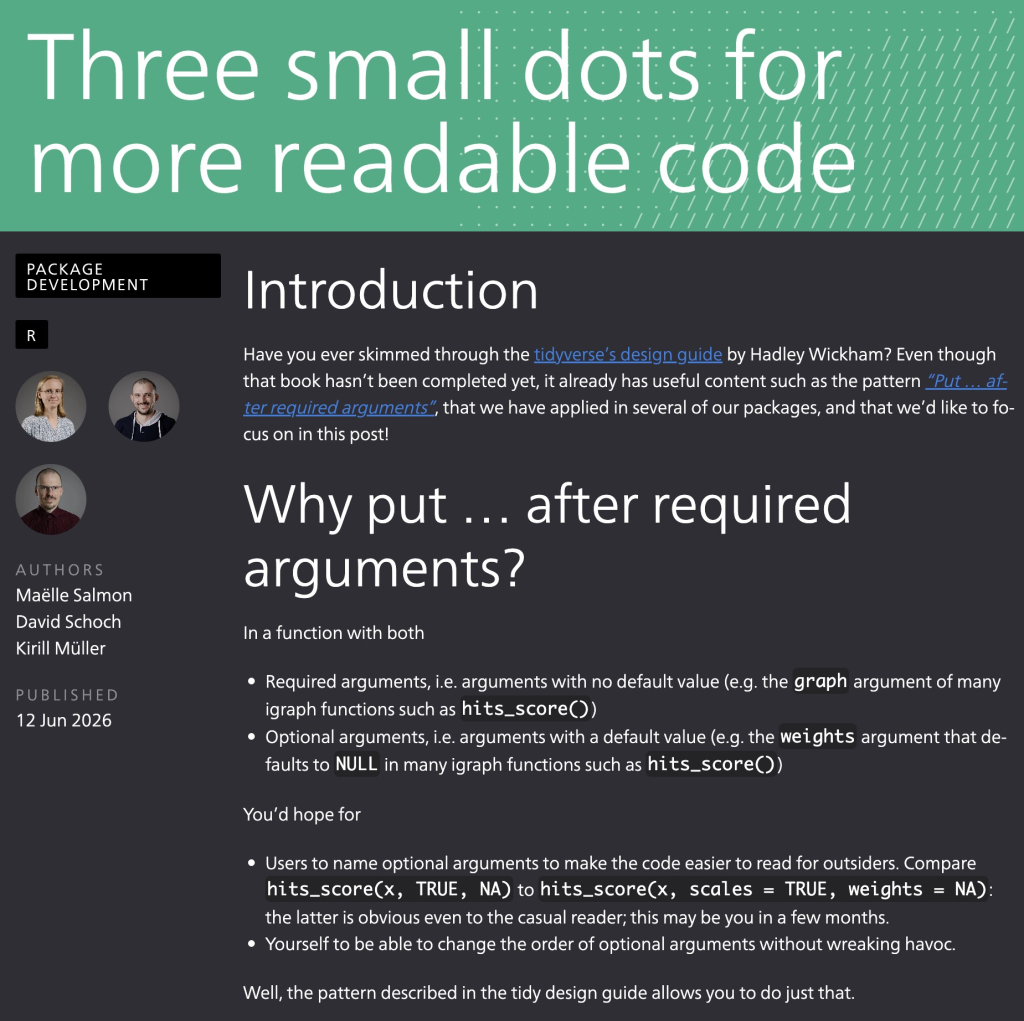
Maëlle Salmon, David Schoch, and Kirill Müller walk through the ... (dot-dot-dot) syntax, which lets one function pass arguments along to another, and the tidyverse principle of placing it after your required arguments so optional ones have to be named. This forces callers to be explicit and prevents the kind of silent positional mismatch where an unnamed argument gets quietly ignored, and they show how to adopt it gracefully in an established package using rlang::check_dots_empty() and {lifecycle} warnings, with {igraph} as the main example. It's a fairly advanced topic, but if you're writing complicated functions it's a really useful overview. I also cover ... in my book, [R for the Rest of Us: A Statistics-Free Introduction](https://book.rfortherestofus.com/packages.html#using-to-pass-arguments-to-another-function), in the chapter on writing your own functions and packages, if you'd like another take on it.
Why Quarto Stuck: Four Years from a Biostatistician's Desk
Mickaël Canouil reflects on four years of daily Quarto use and explains why it became the tool he reaches for across reports, slides, websites, and books. His main argument is that Quarto consolidates what used to take a pile of separate packages (R Markdown, bookdown, xaringan, distill) into a single .qmd file that renders to HTML, PDF via Typst, Reveal.js, a website, or a book from one source, all with sensible defaults and cleaner configuration. He also points to the extension system as the real turning point, letting you build the filters, shortcodes, and formats you need instead of waiting on core features, and shares the 40-plus extensions he's built along the way. As he puts it, Quarto stuck simply because it stopped getting in his way.
If you enjoyed this issue of What’s New In R, please share it with a friend! And if they want to get What’s New in R directly in their inbox, they can sign up on the R for the Rest of Us website.
Got any ideas for resources I should feature in future issues of What’s New in R? Leave a comment below!
Sign up for the newsletter
Get blog posts like this delivered straight to your inbox.



You need to be signed-in to comment on this post. Login.