
What’s New in R: October 19, 2026
Welcome to this week's edition of What's New in R! This week, we're featuring an analysis of why bike crashes in Madison peak in September, a one-liner for using the Equal Earth projection the UN just adopted, and a new framework from Posit for building trustworthy data analysis agents. Let's dive in!
Madison bike crashes peak in September
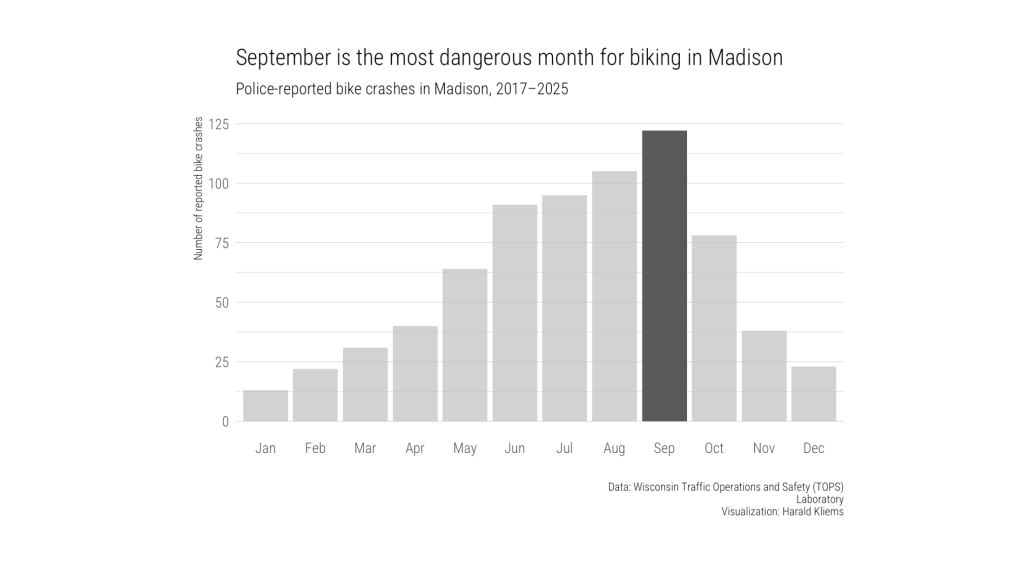
Harald Kliems digs into police-reported crash data from the Wisconsin Traffic Operations and Safety Laboratory to ask why bike crashes in Madison peak in September. It turns out September had the most bike crashes in five of the nine years from 2017 to 2025, with June and August a distant second, and Harald attributes the spike to the start of the UW-Madison semester bringing thousands of new cyclists to town, along with nicer biking weather. The post walks through the analysis with the tidyverse, {gghighlight}, {gt}, and an interactive map made with {tmap} and {sf}. It's a great example of using R to answer a local question with public data.
Use the Equal Earth projection in R right now
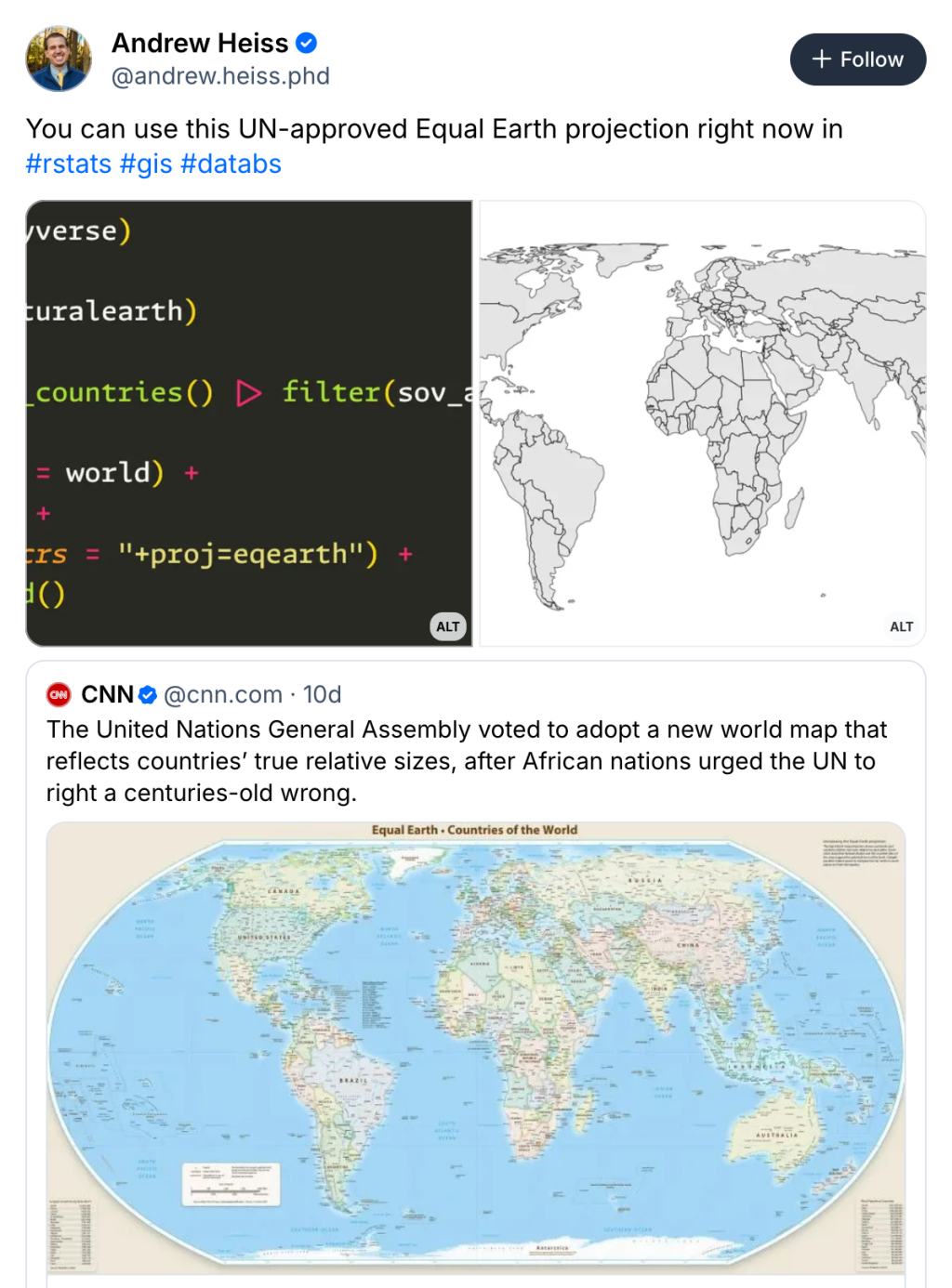
The United Nations General Assembly recently voted to adopt the Equal Earth projection as its standard world map, a projection that shows countries at their true relative sizes after African nations pushed to correct the distortions of the Mercator projection. Andrew Heiss pointed out on Bluesky that you can use it in R right now, and it takes a single line: add coord_sf(crs =
Introducing commons
Simon Couch, Sara Altman, and Josh Taillon introduce {commons}, a new framework from Posit for building self-service data analysis agents in R and Python. The problem it tackles is trust: an agent that's too cautious is useless, but one that freely makes things up is dangerous. {commons} grounds agents in code an analyst has already vetted, and it labels every response based on how it was produced, with a green shield for answers that ran trusted code, a citation mark for answers drawn from provided context, and a warning label for everything else. It's built on {ellmer} and {shinychat}, so it works with whichever model provider you prefer, and you can install it from CRAN today.
If you enjoyed this issue of What’s New In R, please share it with a friend! And if they want to get What’s New in R directly in their inbox, they can sign up on the R for the Rest of Us website.
Got any ideas for resources I should feature in future issues of What’s New in R? Leave a comment below!
Sign up for the newsletter
Get blog posts like this delivered straight to your inbox.



You need to be signed-in to comment on this post. Login.