
What’s New in R: November 2, 2026
Welcome to this week's edition of What's New in R! This week, we're featuring a package that turns an R project into a static website where R runs in the browser, a guide to the growing crowd of R package and environment managers, and color palettes inspired by everyone's favorite Blue Heeler. Let's dive in!
R Workspaces as Static Websites
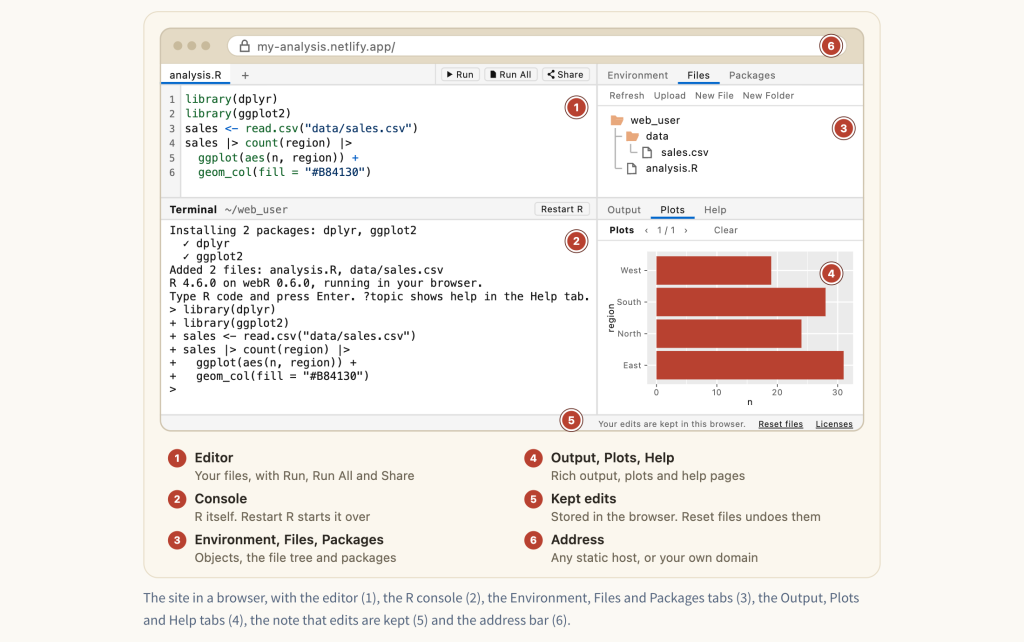
James Balamuta (The Coatless Professor) introduces {webrarian}, a package that bundles your R packages, scripts, and data into a static website where R runs right in the visitor's browser via webR. There's no compute server and nothing to install: people get an RStudio-style workspace with an editor, console, file browser, and plot panel. If you've ever wanted to share an analysis with someone who doesn't have R installed, or give students a ready-to-go environment, this is a really interesting option.
{renv}, {rix}, rv, uvr, ir: An explosion of R package and environment managers
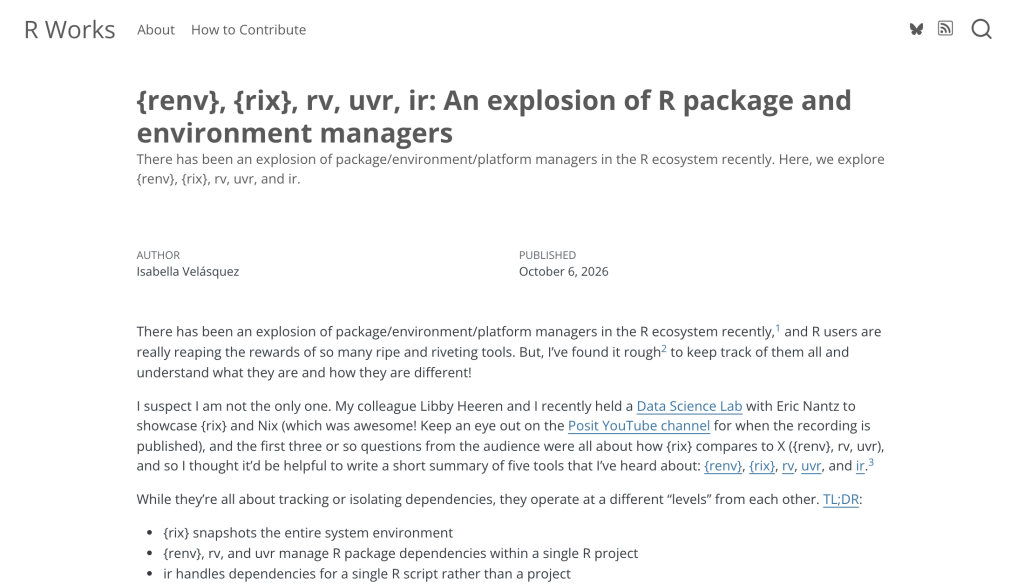
There are suddenly a lot of tools for managing R packages and environments, and Isabella Velásquez has written a helpful guide to five of them on R Works. She explains that they work at different levels: {rix} uses Nix to snapshot your entire system environment (R, packages, and system dependencies); {renv}, rv, and uvr manage package dependencies within a single project (with uvr, modeled on Python's uv, also handling R versions); and ir handles dependencies for a single script or Quarto document. For each one, she covers who makes it, how it works, and what it does and doesn't manage. Isabella doesn't crown a winner, but if you've been confused about how these tools differ, this is a great place to start.
{blueycolors}
If you've got kids (or just love the show), the {blueycolors} package by Eric Ekholm brings color palettes inspired by Bluey to your {ggplot2} charts. It comes with four palettes, Bluey, Chilli, Heeler, and Socks, and Eric notes that Heeler probably has the best contrast. You use scale_color_bluey() and scale_fill_bluey() for discrete data, the c versions for continuous data, and blueypalette() if you just want the hex codes. It's on CRAN, so you can install it and start using it today.
If you enjoyed this issue of What’s New In R, please share it with a friend! And if they want to get What’s New in R directly in their inbox, they can sign up on the R for the Rest of Us website.
Got any ideas for resources I should feature in future issues of What’s New in R? Leave a comment below!
Sign up for the newsletter
Get blog posts like this delivered straight to your inbox.



You need to be signed-in to comment on this post. Login.