
Making Beautiful Tables with R
Add your own ggplot
This lesson is called Add your own ggplot, part of the Making Beautiful Tables with R course. This lesson is called Add your own ggplot, part of the Making Beautiful Tables with R course.
Transcript
Click on the transcript to go to that point in the video. Please note that transcripts are auto generated and may contain minor inaccuracies.
Loading transcript...
Let’s redo our own density plots.
single_species_weights <- penguin_mass$body_masses[[1]]

gg_density_plot <- function(weights) {
  ggplot() +
    stat_density(aes(x = weights), fill = 'dodgerblue4', col = 'grey20') +
    coord_cartesian(xlim = range(penguins$body_mass_g)) +
    theme_void()
}


list_of_ggplots <- map(penguin_mass$body_masses, gg_density_plot)


penguin_mass |>
  flextable() |>
  compose(
    j = 'body_masses',
    value = as_paragraph(
      gg_chunk(
        value = list_of_ggplots,
        width = 3,
        height = 1
      )
    )
)gg_density_box_plot <- function(weights) {
ggplot(mapping = aes(x = weights)) +
stat_density(fill = 'dodgerblue4', col = 'grey20') +
geom_boxplot(width = 0.0005, position = position_nudge(y = -0.0005)) +
coord_cartesian(xlim = range(penguins$body_mass_g)) +
theme_void()
}
list_of_ggplots <- map(penguin_mass$body_masses, gg_density_box_plot)
penguin_mass |>
flextable() |>
compose(
j = 'body_masses',
value = as_paragraph(
gg_chunk(
value = list_of_ggplots,
width = 3,
height = 1
)
)
)Your Turn
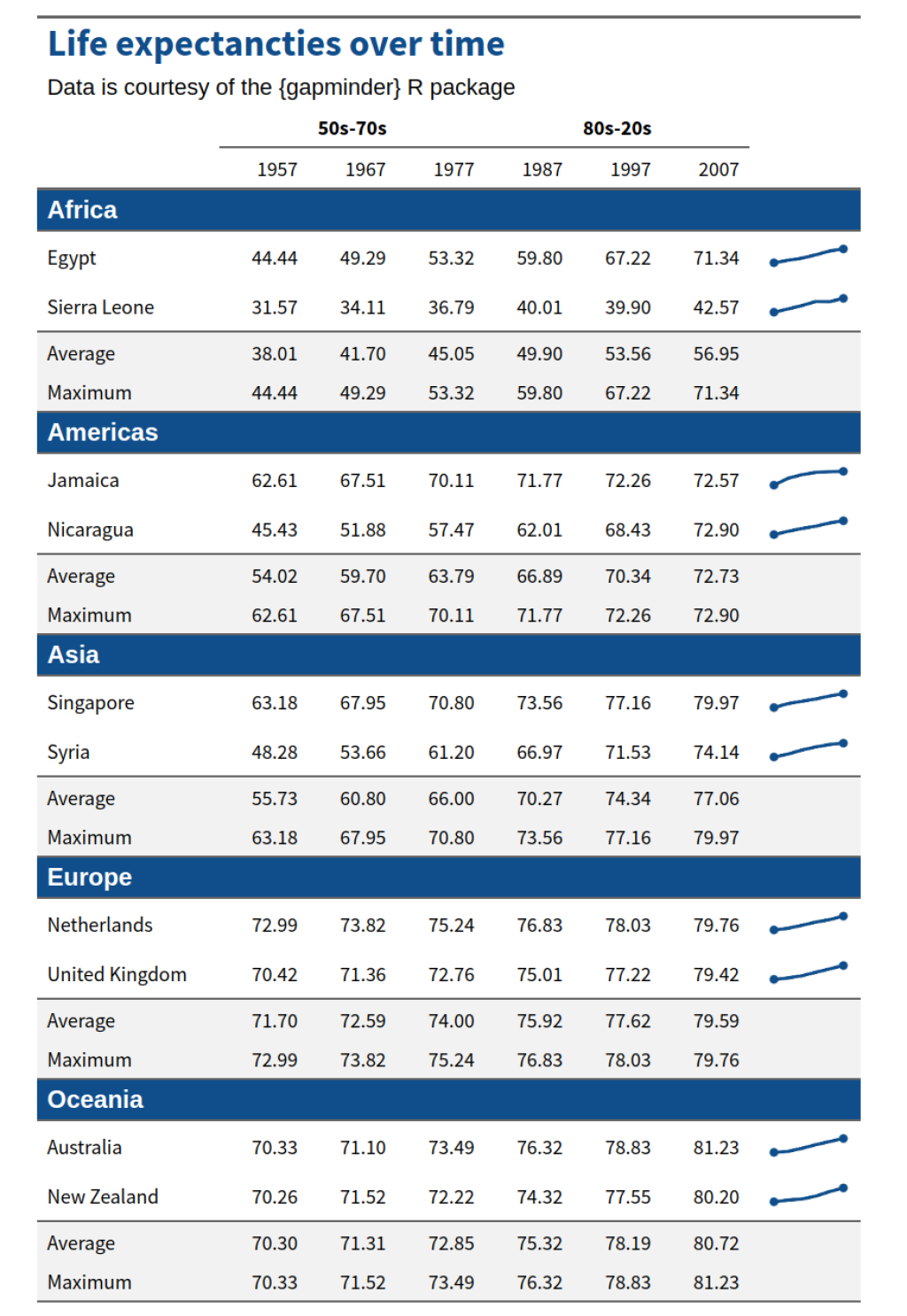
Redo the table from the previous exercise but use ggplot to draw the sparklines. This time, also add small dots at beginning and end of each sparkline.
Hint: If you want, you can manually change the width of the sparkline column with width() after autofit() was called.
Your table should look like this:
Course Content
16 Lessons